The PediSedate: A Winning Combination Of Video Games And Anesthesia
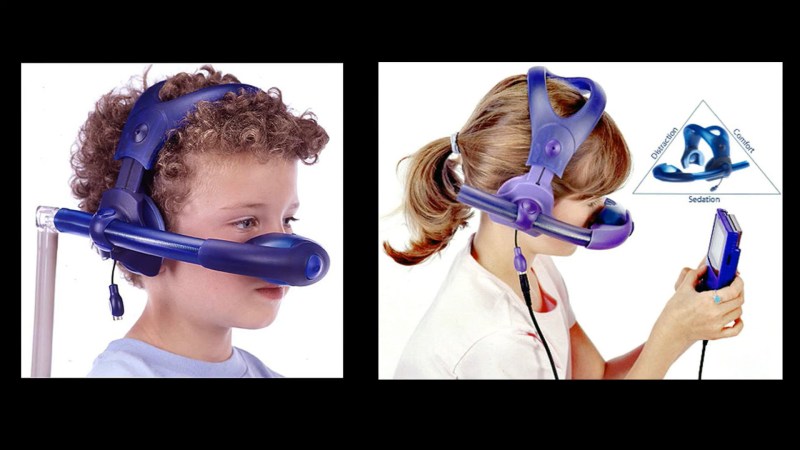
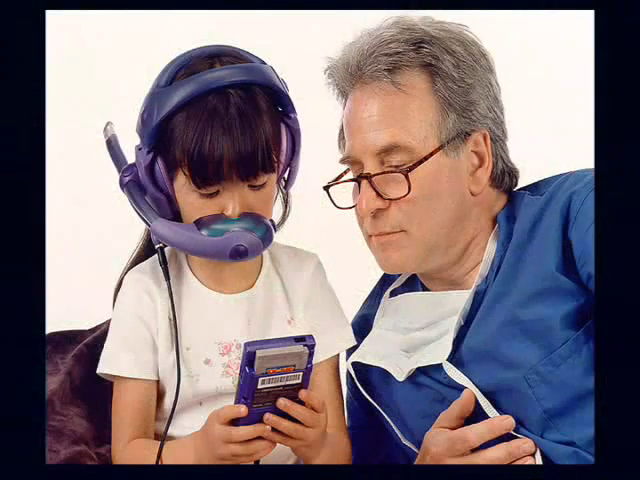
One can understand that it would be nice to have something to focus on while trying to remain calm ahead of a medical procedure. Credit: PediSedate
Once upon a time, surgery was done on patents who were fully conscious and awake. As you might imagine, this was a nasty experience for all involved, and particularly the patients. Eventually, medical science developed the techniques of anaesthesia, which allowed patients to undergo surgery without feeling pain, or even being conscious of it at all.
Adults are typically comfortable in the medical environment and tolerate anaesthesia well. For children, though, the experience can be altogether more daunting. Thus was invented the PediSedate—a device which was marketed almost like a Game Boy accessory intended to deliver anaesthetic treatment in order to safely and effectively prepare children for surgery.
A Happy Distraction
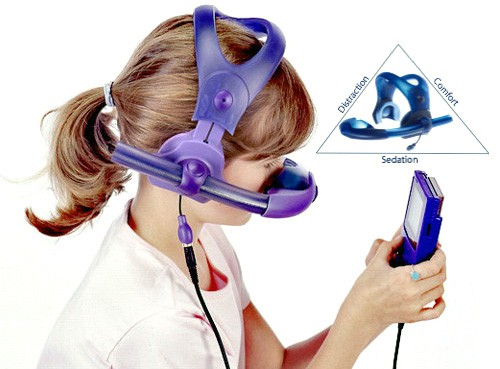
A child wearing the PediSedate mask. Credit: PediSedate
The patent filing for the PediSedate doesn’t give away much in the title—”Inhalation And Monitoring Mask With Headset.” Still, US patent 5,697,363 (PDF) recorded an innovative device, intended to solve several issues around the delivery of anaesthesia to pediatric patients. Most specifically, those developing the device had noted a great deal of anxiety and stress when using traditional anaesthesia masks with young patients. The device was created by Geoffrey A. Hart, an anaestheologist based in Boston. His hope was to create an anaesthesia delivery device that could be used with a child in a “non-threatening, non-intrusive manner.”
The resulting device looked rather a lot like a big, colorful audio headset. Indeed, it had headphones to that could play audio to the wearer, while an arm that extended out over the face could deliver nitrous oxide or other gases via the nasal route. Sensors were included for pulse oximetry in order to track the patient’s heart rate and blood oxygenation, while an integrated capnometer measured vital respiratory factors including carbon dioxide levels in the breath. Provision in the patent was also made for including a microphone, either for interactivity purposes with entertainment content for distraction’s sake, or to allow communication with medical personnel at a distance. This would be particularly useful in the case of certain imaging studies or treatments, where doctors and nurses must remain a certain distance away.
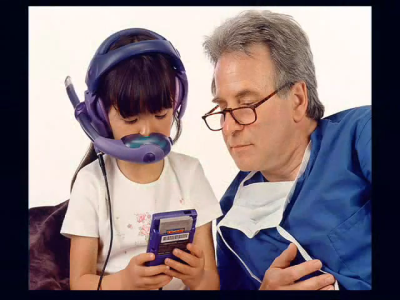
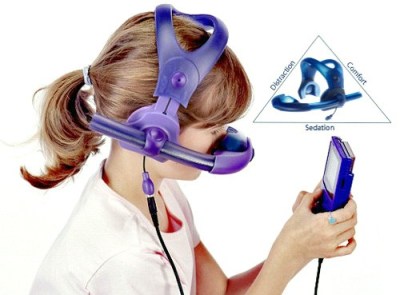
Press materials that showed the device in use with a handheld created the idea that this was a Game Boy accessory. It was certainly never an official one; in reality, it was a pair of headphones that also delivered anaesthesia while monitoring the patient. Credit: PediSedate
Press materials and a website were launched in 2009, as the device went through Phase II clinical trials. Most materials showed the PediSedate being used in tandem with a Nintendo Game Boy. The device featured an aesthetic that followed the late 90s trend of bright colors and translucent plastics. It was often paired in photos hooked up to a Game Boy to help distract a child during sedation, with the device often talked about as an “accessory” for the handheld console. This wasn’t really the case—it was essentially a child-friendly anaesthetic mask with headphones that could be hooked up to any relevant sound source. However, at the time, a Game Boy was a readily available way to distract and calm a sick child, and it could be had in colors that matched the PediSedate device.
Those behind the PediSedate noted the device was “very well recieved by parents, kids and health-care workers.” The benefits seem to pass the common-sense check—it’s believable that the PediSedate succeeded at being a less-scary way to present children with anaesthetic treatment while also giving them something pleasant to focus on as they drifted out of consciousness. However, success was seemingly not on the cards. The PediSedate website disappeared from the internet in 2011, and precious little was heard of the device since. The creator, Geoffrey A. Hart, continued to practice medicine in the intervening years, until he resigned his license in 2024 according to the Massachusetts Board of Medicine.
youtube.com/embed/-teN8JcqLZQ?…
An explainer video demonstrated the use of the device, which was going through Phase II trials in 2009.
By and large, the medical field has gotten by without devices like the PediSedate. Children undergoing sedation with inhalational anaesthetics will typically be treated with relatively conventional masks, albeit in small sizes. They lack colorful designs or hookups for game consoles, but by and large seem to do the job. It might have been nice to play a little Donkey Kong before a daunting procedure, but alas, the PediSedate never quite caught on.
Featured image: still from Sharkie’s Gaming Controllers video on the PediSedate.
hackaday.com/2025/12/17/the-pe…