Citiverse è uno spazio aperto a tutte le comunità. Se vuoi aprire un gruppo locale o una sezione per la tua organizzazione, puoi contattare gli amministratori: pagina dei contatti.
Google Is Closing Android: And Taking Your Freedom With It
-
This post did not contain any content.
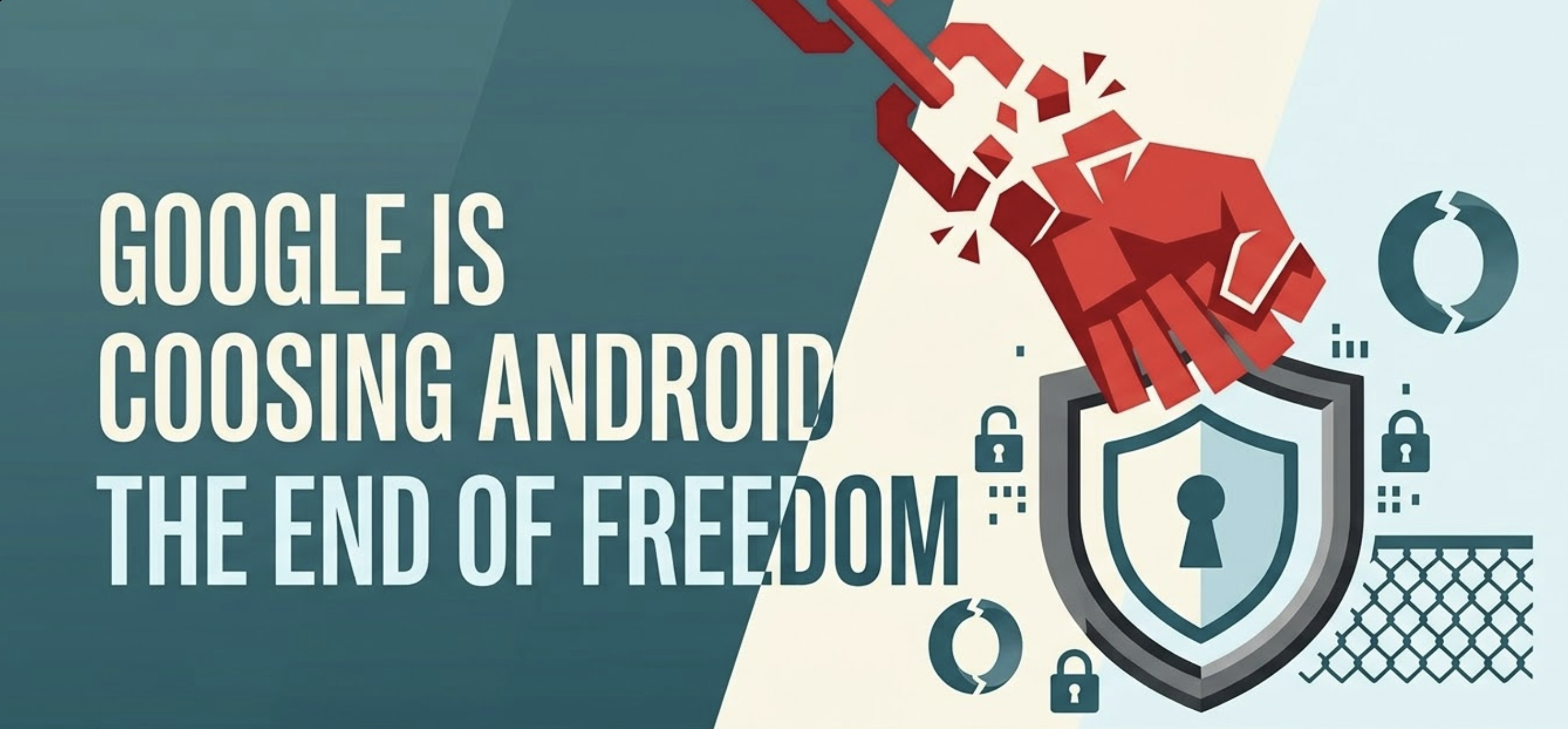
Google Is Closing Android: And Taking Your Freedom With It | PixelUnion - Free your photos from American tech platforms
Google is systematically dismantling the open Android ecosystem: forcing all developers to register with Google, slowing AOSP releases, and effectively turning Android into a walled garden. Here is what is at stake.

PixelUnion - Free your photos from American tech platforms (pixelunion.eu)
-
This post did not contain any content.
Google Is Closing Android: And Taking Your Freedom With It | PixelUnion - Free your photos from American tech platforms
Google is systematically dismantling the open Android ecosystem: forcing all developers to register with Google, slowing AOSP releases, and effectively turning Android into a walled garden. Here is what is at stake.
PixelUnion - Free your photos from American tech platforms (pixelunion.eu)
That's why Android needs to be forked and have an independente development asap.
EU is ditching big US corporations, however Google is restricting third party app stores, and control over which apps can be installed.
Google Services are built-in on almost Android devices, giving access to everything that happens on those devices (phones, tablets, Android TV...), which is basically an rootkit, it can remotely access any app, any file, and control the device.
EU and any other nation needs an alternative to Android or iOS, truly open source without external control of any corporation
-
That's why Android needs to be forked and have an independente development asap.
EU is ditching big US corporations, however Google is restricting third party app stores, and control over which apps can be installed.
Google Services are built-in on almost Android devices, giving access to everything that happens on those devices (phones, tablets, Android TV...), which is basically an rootkit, it can remotely access any app, any file, and control the device.
EU and any other nation needs an alternative to Android or iOS, truly open source without external control of any corporation
That's basically what GrapheneOS is, and why I'm hopeful that Motorolla and other vendors start releasing devices using it. The main risk is that Google will cut off its services and store from it, and if there are official vendors making devices then it'll be harder to do that.
-
That's basically what GrapheneOS is, and why I'm hopeful that Motorolla and other vendors start releasing devices using it. The main risk is that Google will cut off its services and store from it, and if there are official vendors making devices then it'll be harder to do that.
True, Graphene would be a good start.
China don't have Google PlayStore, but only their own apps market, also Amazon and Samsung have their own app stores.
It's not impossible to have a different apps market, it there's an user base, and developers will follow the market
-
That's basically what GrapheneOS is, and why I'm hopeful that Motorolla and other vendors start releasing devices using it. The main risk is that Google will cut off its services and store from it, and if there are official vendors making devices then it'll be harder to do that.
At some point we're going to want to ditch Google's services entirely. This is simply a trust/societal problem, not an engineering one. Most proprietary apps rely on Google's app attestation. The main hurdle I see for an Android fork becoming mainstream without Google is establishing a 3rd party root of trust, like how SSL already works. It is actively against Google's interest to allow this to happen, so they will push as much closing of their OS as they can without "boiling the frog" so to speak.
-
That's basically what GrapheneOS is, and why I'm hopeful that Motorolla and other vendors start releasing devices using it. The main risk is that Google will cut off its services and store from it, and if there are official vendors making devices then it'll be harder to do that.
Yeah, I'm waiting for the same thing, and even if they cut off their services, so long as the phone can be degoogled and replacements installed I wouldn't really care.
Banking apps could be the only problem I foresee, but then I guess I'll just go back to debit and credit cards.
-
Yeah, I'm waiting for the same thing, and even if they cut off their services, so long as the phone can be degoogled and replacements installed I wouldn't really care.
Banking apps could be the only problem I foresee, but then I guess I'll just go back to debit and credit cards.
I find the big one is communication platforms. A lot of people use stuff like Slack or Discord, and if you need to use these platforms you're kinda screwed.
-
True, Graphene would be a good start.
China don't have Google PlayStore, but only their own apps market, also Amazon and Samsung have their own app stores.
It's not impossible to have a different apps market, it there's an user base, and developers will follow the market
Yeah, if there was an independent app store that popular apps would get published to that would be ideal.
-
This post did not contain any content.
Google Is Closing Android: And Taking Your Freedom With It | PixelUnion - Free your photos from American tech platforms
Google is systematically dismantling the open Android ecosystem: forcing all developers to register with Google, slowing AOSP releases, and effectively turning Android into a walled garden. Here is what is at stake.
PixelUnion - Free your photos from American tech platforms (pixelunion.eu)
They couldn't even fucking be bothered to spell check their slop banner?
-
That's basically what GrapheneOS is, and why I'm hopeful that Motorolla and other vendors start releasing devices using it. The main risk is that Google will cut off its services and store from it, and if there are official vendors making devices then it'll be harder to do that.
From my understanding, Graphene is still extremely dependent on upstream development of Android so they can focus on their security improvements. I don't think they have the manpower to properly fork it.
-
From my understanding, Graphene is still extremely dependent on upstream development of Android so they can focus on their security improvements. I don't think they have the manpower to properly fork it.
There is a solid basis though, and it wouldn't be unthinkable to create a foundation around it that could take it forward on its own. And if there are vendors shipping it, then some money might get thrown at the effort too.
-
There is a solid basis though, and it wouldn't be unthinkable to create a foundation around it that could take it forward on its own. And if there are vendors shipping it, then some money might get thrown at the effort too.
I unfortunately think you underestimate the workload here. Developing an OS is a massive undertaking, and it would require a huge community of developers to come forward and take up the job. I just don't see it happening spontaneously. In my opinion, if they ever lose upstream support, Graphene just dies.
-
They couldn't even fucking be bothered to spell check their slop banner?
I read the sloptext as "Goosing Android" initially, which seemed to make sense!
-
I unfortunately think you underestimate the workload here. Developing an OS is a massive undertaking, and it would require a huge community of developers to come forward and take up the job. I just don't see it happening spontaneously. In my opinion, if they ever lose upstream support, Graphene just dies.
And Android piggybacks on Linux. Turtles all the way down, until you get the actual developers committing real effort. And no one is talking about spontaneously, rather realistically 0.5-20 million euros in funding from the EU. Is it viable then? If not, realistically, what would be the threshold for viability?
-
This post did not contain any content.
Google Is Closing Android: And Taking Your Freedom With It | PixelUnion - Free your photos from American tech platforms
Google is systematically dismantling the open Android ecosystem: forcing all developers to register with Google, slowing AOSP releases, and effectively turning Android into a walled garden. Here is what is at stake.
PixelUnion - Free your photos from American tech platforms (pixelunion.eu)
Can someone tell me why legislation hasn't stepped in yet?
I honestly don't understand this.
The EU made Microsoft show a pop up on Windows so users could choose their own browser. And this was idk how many years ago.
Yet it seems to be perfectly ok for OEM's to make phones where it's impossible to install another OS on... -
Can someone tell me why legislation hasn't stepped in yet?
I honestly don't understand this.
The EU made Microsoft show a pop up on Windows so users could choose their own browser. And this was idk how many years ago.
Yet it seems to be perfectly ok for OEM's to make phones where it's impossible to install another OS on...yeah, you'd think an open mobile stack would be at the top of the priority list when it comes to tech sovereignty
-
I unfortunately think you underestimate the workload here. Developing an OS is a massive undertaking, and it would require a huge community of developers to come forward and take up the job. I just don't see it happening spontaneously. In my opinion, if they ever lose upstream support, Graphene just dies.
I'm not saying it would be easy or would happen spontaneously, just that it's not impossible. There is already a solid base to work off and there is a lot of interest in having an open mobile platform. I reject the notion that only large corps can do such things.
-
Can someone tell me why legislation hasn't stepped in yet?
I honestly don't understand this.
The EU made Microsoft show a pop up on Windows so users could choose their own browser. And this was idk how many years ago.
Yet it seems to be perfectly ok for OEM's to make phones where it's impossible to install another OS on...And this was idk how many years ago.
There's your answer. No one cares anymore.
-
I find the big one is communication platforms. A lot of people use stuff like Slack or Discord, and if you need to use these platforms you're kinda screwed.
I've used the discord web client on graphene quite a lot. It has fewer features than the app but I feel better about it. Same with my bank- I can just log into the website via my phone's browser.
-
This post did not contain any content.
Google Is Closing Android: And Taking Your Freedom With It | PixelUnion - Free your photos from American tech platforms
Google is systematically dismantling the open Android ecosystem: forcing all developers to register with Google, slowing AOSP releases, and effectively turning Android into a walled garden. Here is what is at stake.
PixelUnion - Free your photos from American tech platforms (pixelunion.eu)
- Embrace open source
- Extend services into proprietary layers (Google Play Services)
- Extinguish third party development
We're entering the final phase of Microsoft's famous EEE strategy from the 90s.






Ciao! Sembra che tu sia interessato a questa conversazione, ma non hai ancora un account.
Stanco di dover scorrere gli stessi post a ogni visita? Quando registri un account, tornerai sempre esattamente dove eri rimasto e potrai scegliere di essere avvisato delle nuove risposte (tramite email o notifica push). Potrai anche salvare segnalibri e votare i post per mostrare il tuo apprezzamento agli altri membri della comunità.
Con il tuo contributo, questo post potrebbe essere ancora migliore 💗
Registrati Accedi




 Citiverse è un progetto che si basa su NodeBB ed è federato! | Categorie federate | Chat | 📱 Installa web app o APK | 🧡 Donazioni | Privacy Policy